
Every few years, usually the morning after an April frost has walked through the young shoots, a European winemaker opens a browser and checks land prices in Tasmania. It is a healthy fantasy: warm-but-not-too-warm nights, a jurisdiction that speaks English, and - surely - less paperwork than home.
The paperwork part is where the fantasy needs an edit. Australia does not hand you fewer forms. It hands you a differently shaped stack, enforced by a different party, on a calendar that runs backwards from the one your muscle memory is built on. This is what changes in the daily work of whoever keeps the records: the grower filling the diary after a spray pass, the winemaker signing off a blend before bottling.
Who regulates what
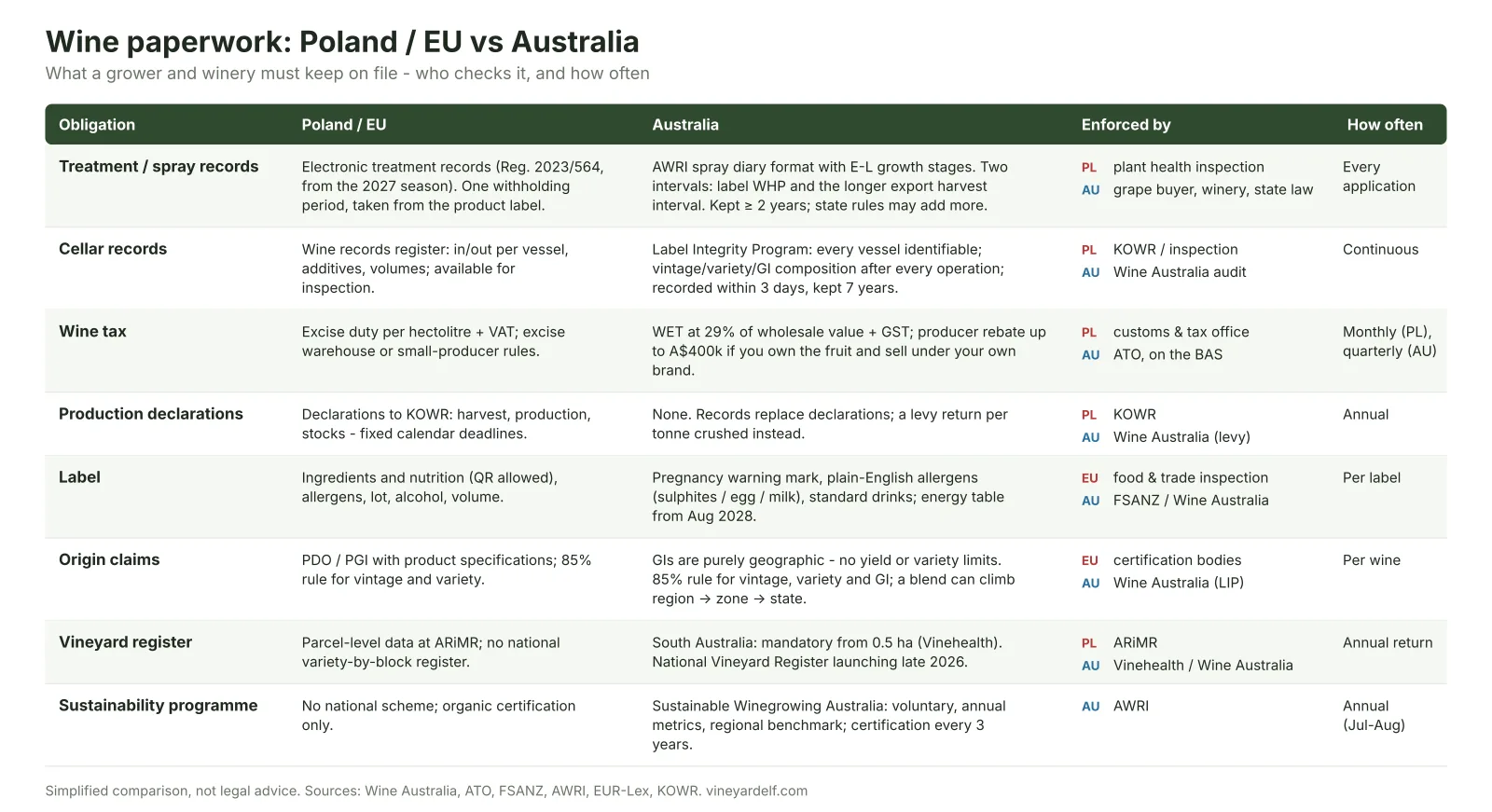
In Europe, wine sits under the EU Common Market Organisation, with the detail written into implementing and delegated regulations and then enforced by your own member state's authorities. The practical texture of that is declarations. You declare your harvest, your stock, your production. Somebody at a regional or national office is expecting a filing from you on a schedule, and the default posture is that you send paperwork upward and outward.
Australia splits the job across several desks. One federal authority, Wine Australia, runs origin and export integrity. The tax office runs the Wine Equalisation Tax. Food Standards Australia New Zealand writes the label and composition rules. State governments handle liquor licensing. No single ministry owns "wine" the way a European grower expects.
The posture is different too. Australia leans on records you keep and produce on demand. You are not filing a harvest declaration to a bureau every year so much as maintaining books that must survive an audit. For the person on the ground it means the European reflex ("what is the deadline to submit this?") gets replaced by an Australian one ("can I reconstruct this instantly if someone asks?").
Europe files declarations. Australia keeps records and gets audited.
Treatment records vs the spray diary
Both hemispheres want to know what you put on the vines. What differs is the format and, crucially, who reads it.
In Europe the direction of travel is toward electronic records of plant protection product use, with the framework pointing toward the 2027 season. The relevant text to watch is Commission Implementing Regulation (EU) 2023/564 on the records professional users keep - treat the exact wording and the precise switch-on date as something to confirm there rather than a promise from a blog. The direction is clear even where the fine print is still settling. What you record does not really change: product, active substance, dose, date, block, operator, reason. What changes is that the paper notebook in the tractor shed stops being good enough, and the data has to be structured.
Australia has no single government spray-diary form. Instead the format is effectively set by whoever buys your fruit. Wineries hand growers a required template, very often aligned to the AWRI (Australian Wine Research Institute) recommendations, and if you want your grapes accepted you fill it in their way. Your real inspector is not a public servant, it is the buyer's intake team.
And you are managing two clocks, not one. The domestic withholding period tells you how long after spraying you may harvest for sale at home. The export harvest interval can be longer, because the residue limits that actually bite are set by the destination market - China, Japan, the EU - not by Australia. A spray that is legal for domestic fruit can quietly disqualify the same block for an export parcel. The grower who ignores that difference does not get a fine; they get their fruit rejected at the weighbridge, which is worse.
The contrast is really one of philosophy. Europe tells you what you may spray and when to stop; Australia lets the market's residue limits set the clock, and hands you the pen.
Cellar register vs the Label Integrity Program
Here is the reassuring bit for anyone who has fought with a European cellar register: the headline rule travels. The 85% principle - that a stated vintage, variety or origin must be at least 85% true - exists on both sides.
The European cellar register is built on in-and-out logic. Every movement of wine gets booked: what came in, what went out, what you added, what you lost. Auditors reconstruct your year by walking that ledger.
Australia's version is the Label Integrity Program (LIP), and it is stricter in a specific way. Every vessel must be identifiable. Every operation - a blend, a transfer, an addition - must be recorded within three days. Records must be kept for seven years. Enforcement carries criminal penalties, not just administrative ones, because the point of LIP is to protect the credibility of Australian wine as an export brand. If you use a contract packager, they need the composition of what they are bottling on the same day they bottle it. The three-day habit is the thing a European operator has to internalise: you cannot batch up a week of cellar work and write it up on Friday.
Origin
This is where the two systems genuinely think differently, and it changes what you are allowed to claim.
European PDO and PGI come with specifications. The appellation dictates permitted varieties, yield caps, sometimes vineyard practices. Origin in Europe is a promise about how the wine was made, not only where the grapes grew.
Australian Geographical Indications are purely geographical. A GI tells you the fruit came from that place. It does not cap your yield, hand you a list of approved varieties, or tell you how to farm. Blending across regions is free. The only hard rule is honesty: you cannot claim a region, variety or vintage you did not put in the bottle, back to that same 85% line.
That freedom enables a move the European system structurally forbids. If a wine will not qualify for a tight regional claim, you can climb the hierarchy - label it by the broader zone, or simply as South Eastern Australia, a vast multi-state zone - and it is entirely legitimate. In Europe you cannot demote a Barolo to "generic Italian red" and treat that as a feature. In Australia, moving up the geographic ladder is a normal commercial decision, and your records have to support whichever rung you land on.
Tax
European excise on wine is a patchwork. Rates vary by country, and several member states set still-wine duty at zero. It is a border-and-warehouse concern more than a daily one.
Australia runs the Wine Equalisation Tax: 29% on the wholesale value of wine. That number frightens people until they meet the producer rebate, which effectively exempts a large slice of small-producer output. The catch is ownership. To claim the rebate you generally have to prove you owned the fruit through the whole process, from vineyard to finished wine. Which loops straight back to the Label Integrity Program: the vessel-by-vessel records that prove your 85% claims are the same records that prove ownership for the rebate. Keep LIP well and your tax position looks after itself; keep it badly and you can lose both at once.
Good records are not just compliance. They are cash.
Labels
Both hemispheres are, from the drinker's point of view, converging on the same instruction: tell the consumer more.
Europe now expects ingredients and a nutrition declaration, with the option to carry the detail off-label via a QR code - a pragmatic escape valve when there is only so much room on the glass. Australia requires a pregnancy warning pictogram, allergens in plain English, and is phasing in an energy (kilojoule) statement over its own timeline. The icons and wording differ, but the operator's takeaway is identical on both sides of the equator: the back label is becoming a data sheet, and "we always did it this way" is not a defence in either market.
The sane way to handle that is not two label projects but one: design a single label brain that can output two compliant faces, EU and Australian, from the same underlying record.
The calendar problem
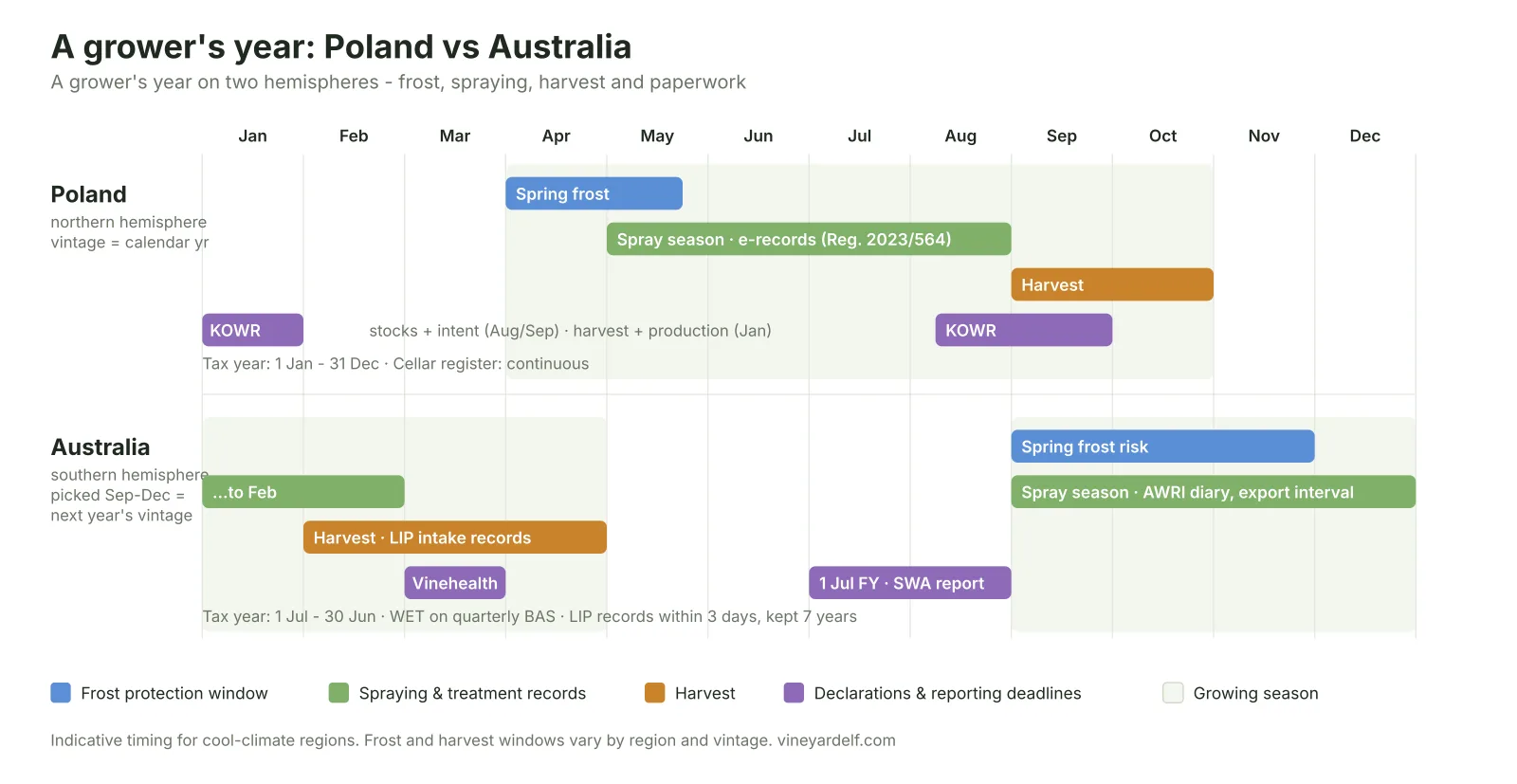
This is the one that quietly breaks spreadsheets and half of the software people bring with them.
Southern-hemisphere harvest runs February to April. Frost risk lands in September through November, your spring. The financial year starts on 1 July. And the convention that catches everyone: grapes picked late in the calendar year, September through December, are counted as the following year's vintage. A block harvested in early autumn and one harvested at the tail of the year can carry different vintage labels while feeling, to you, like the same season.
For a grower moving hemispheres this is not trivia. Every date-driven habit - when frost alerts matter, when the withholding clock starts, which vintage a parcel belongs to - has to be re-pegged. Any tool worth using has to know which hemisphere the vineyard sits in before it can file a spray record in the right season or a harvest in the right vintage year. A system that silently assumes northern seasons will file your autumn work under the wrong year, and you will find out at audit.
What Europe could borrow
The annually curated agrochemical list is the obvious one. Rather than leaving each grower to reconcile shifting national and EU residue rules against export markets, a single list, refreshed each season, of what is usable and for which destination would save a lot of guesswork. Australia's second good idea is the voluntary sustainability program benchmarked against regional peers - a way to show progress without waiting for a mandate. And several European countries are only now building the kind of national vineyard register that would make all of this auditable in one place.
What Australia could borrow
The appellation specification. GIs are honest but thin. A grower who wants to signal that a wine was made a particular way, not just grown in a particular postcode, has no framework to lean on. Europe's specifications, for all their bureaucracy, give that promise a shape.
And the one every grower would feel immediately: a single, industry-wide electronic records standard instead of every winery handing out its own diary template. Right now a grower selling to three wineries can be keeping the same spray data in three formats. Europe's move toward one common electronic standard is exactly the annoyance Australian growers would love to lose.
Two vineyards, one habit
Strip away the acronyms and both systems ask the same thing of the person keeping the books: record what you did to the fruit, record what went into the vessel, and be able to prove both fast. The shape differs, the enforcer differs, the calendar flips. The frost still comes. It just comes in October.
Try it
- Growing in Europe? Get your treatment records in shape for the electronic shift that is coming, with automatic weather from your own station on the way. Start with VineyardElf
- Growing in Australia? A spray diary built to match the format your winery asks for, on a southern-hemisphere calendar that counts the vintage year correctly - both features we are building for the reversed season. Start with VineyardElf
VineyardElf handles both hemispheres. You keep the records; we keep them in the shape each side expects.