Episode: "Vineyard (and winery) transformation through automation"
Guest: David Allen, Transformation Manager – Viticulture, Pernod Ricard Winemakers New Zealand
Host: Drew (AWRI) · 18 minutes · 12 September 2022
This is a summary in our own words plus our commentary. It is not AWRI material or an authorised transcript.
On the other side of the world, in Marlborough, the tractors drive themselves. Four of them, no driver, across eight hundred and fifty hectares. We farm 0.22 hectares in eastern Poland, and this episode made us ask an honest question: does it have anything to do with us at all?
In short
- David Allen from Pernod Ricard Winemakers in New Zealand talks on the AWRI podcast about technology adoption and automation in vineyards.
- The star is Oxin, an autonomous vineyard tractor built together with Smart Machine, a local Marlborough agri-tech startup.
- Four machines cover 850 hectares, running "missions" set by an operator: mowing, mulching, leaf removal and trimming.
- The real bottleneck is not the technology, it is people's readiness to change. That comes from someone whose company has a budget for exactly that.
- For a 0.22-hectare vineyard the machine itself makes no sense. The principle behind it does.
What the episode is about
David Allen leads viticulture transformation at Pernod Ricard Winemakers. In New Zealand, Pernod Ricard is the second-largest wine producer, with brands like Brancott Estate and Stoneleigh and vineyards spread mostly across Marlborough. Scale is the point here, because scale is the axis of the whole conversation. When Allen talks about automation, he talks about it from the perspective of hundreds of hectares and labour costs that, at that size, move the needle.
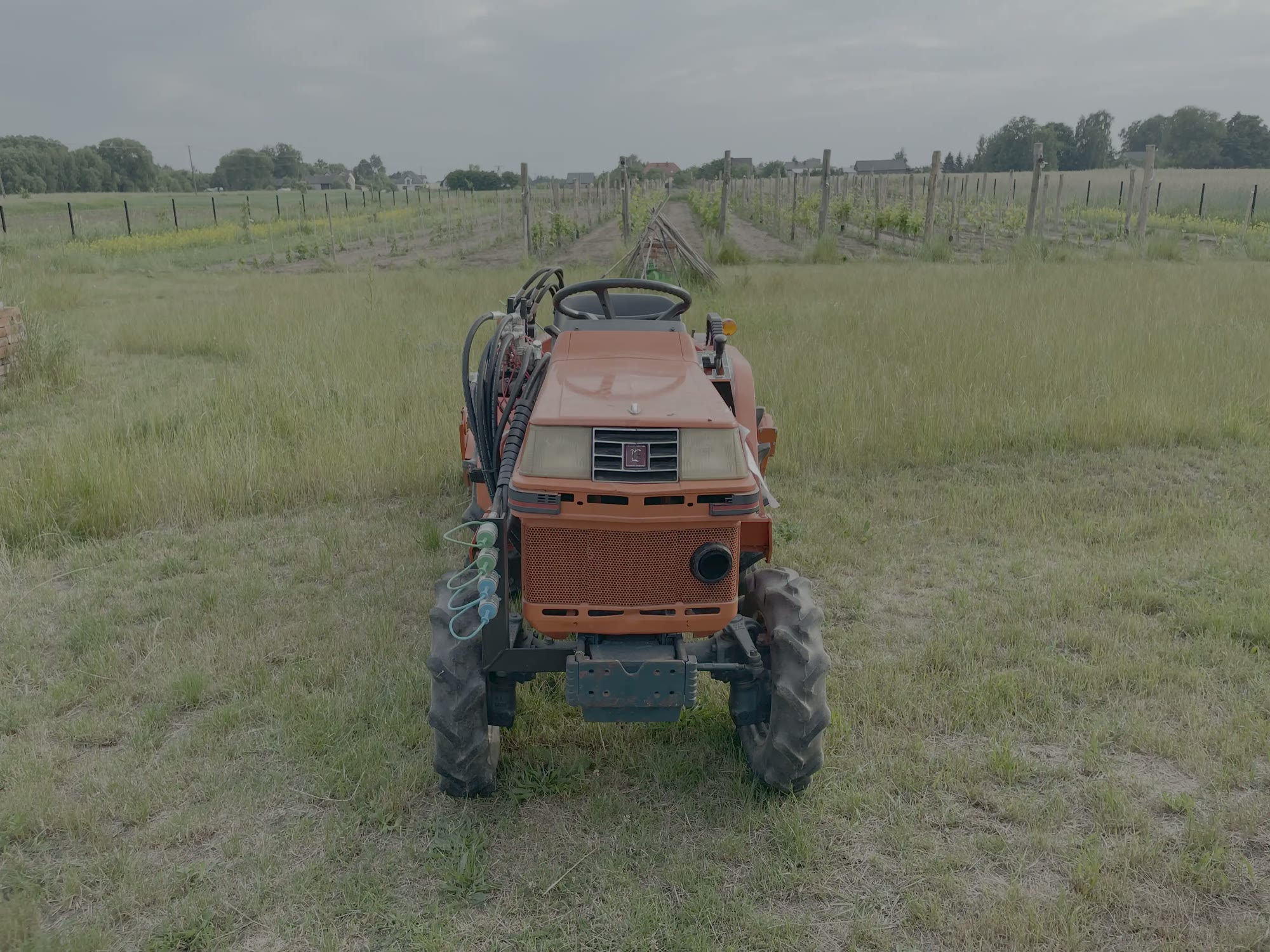
The concrete example is Oxin: an autonomous vineyard tractor that Pernod Ricard develops together with the Marlborough startup Smart Machine. The split is simple. The winery brings the money and the vineyard knowledge; the startup brings the engineering and the software. The result is four machines piloting a block of 850 hectares.
How they work is more interesting than "the tractor drives itself". The operator does not steer. They assign the machine a "mission". The vehicle knows the previously taught topography of the block and moves through it on its own, and when it meets something unexpected it stops and waits until a human confirms it is safe to continue. On top of that comes fleet learning: when one machine learns something about a stretch of the vineyard, all the others get that knowledge. The tasks are mowing, mulching, leaf removal and trimming. Notice what is not on that list: no spraying, and no frost protection.
The tone is very "Fourth Industrial Revolution". Pernod Ricard's transformation director, Alex Kahl, spoke around the programme about exactly that, "the Fourth Industrial Revolution" and the pride of leading the industry toward autonomous tractors. But the most interesting line of the episode is less flashy. Allen keeps coming back to the idea that the real obstacle is not whether the machine will work, but whether people in the organisation will change the way they work. The bottleneck is adoption, not technology. And that comes from someone who has a dedicated implementation team and an R&D budget.
What it means for a small, family vineyard
This is where the episode stops being a curiosity from the far side of the planet, and where the only reason worth summarising it begins.
The contrast in scale is brutal. An autonomous tractor makes sense where there are hundreds of hectares and labour costs that a one- or two-hectare vineyard simply does not have. Oxin will not scale down to our vineyard in this form, because there is no reason to. Let us be honest: a robot that costs as much as a flat, to mow a fifth of a hectare, is not the future, it is a joke.
But the principle will scale down. Automation is not "a big machine drives itself". It is "a system made a decision and acted while nobody was there". In Marlborough that is a tractor mowing between rows. On our patch it is a valve that opens at 3:40 in the morning, when the sensor reads minus 1.2 degrees and we are asleep a hundred kilometres away. It is exactly the same question, only the answer has a different scale and a different price tag. And that version of the question matters far more to a small grower than driving between rows.
Adoption, not technology, is the bottleneck, and it cuts both ways. If Allen, inside a company with an R&D budget, worries about resistance to change, then for a hobbyist grower the problem is the same, only without an implementation team to push it through. Which leads to a very concrete conclusion for anyone building tools for vineyards like ours. Simplicity of setup beats number of features. If wiring up a sensor and a valve controller takes an evening rather than a week with a manual, the technology has a chance. If not, it ends up in a drawer next to other good ideas. That, by the way, is the point around which we build VineyardElf, and one we think about more than any single feature.
Small growers carry problems Marlborough does not. Spring frost that can wipe out a season in a single night. Fragmented plots. The record-keeping and paperwork every grower has to keep up with. So automation for a small vineyard starts in a completely different place than in New Zealand. Not with driving between rows, but with frost protection and with the documentation that has to be produced anyway. That is not a worse starting point. It is simply a different one, matched to what actually keeps you awake at night on a fifth of a hectare.
Worth a listen if...
Worth it if you are interested in where viticulture is heading at industrial scale and you like hearing from people who actually deploy technology rather than just talk about it. Eighteen minutes in English is a real barrier if that is not your language, and there is no point pretending otherwise. If you run a small vineyard and you are looking for something to use right now, this particular episode will not give you much directly. The value is in the principle, not the machine, and the principle is summarised above.
Sources and links from the episode: AWRI decanted on Spotify · "Mission possible: Driving autonomous technology in New Zealand vineyards" · Oxin (Pernod Ricard Winemakers)
We write from a 0.22-hectare family vineyard in eastern Poland, after three seasons of fighting spring frost. If you are doing something similar, wherever you are, get in touch. You will find more of these summaries and field notes on the VineyardElf blog.