
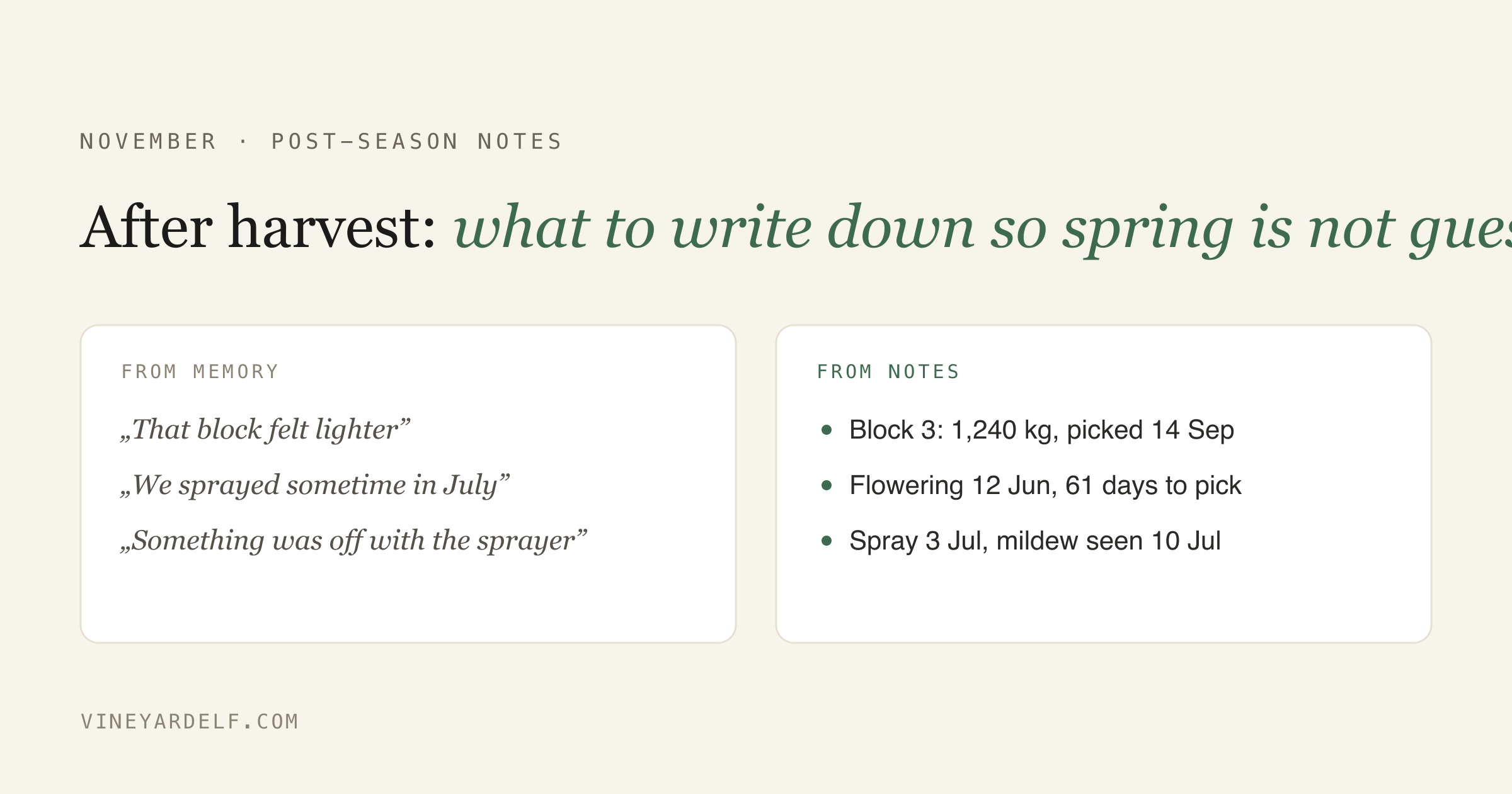
Harvest is over, the must is working, and the whole season is still fresh in your head: which block yielded more, where the mildew sat, which row ripened a week late. In four months all of that becomes an impression rather than knowledge. That is why November is the best time for the notes that will save you from guessing in spring. This is not about the registers the law requires, but about your own working notes from the vineyard.
Yield per block, not per vineyard
Total harvest weight tells you very little. Only the split by block and variety shows where you are working for free. Write down the weight picked from each block, the picking date and the must numbers if you measured them. After two seasons you will see that one block is consistently ten or fifteen percent lower, and then the question becomes specific: soil, exposure, rootstock, or simply the age of the planting.
Dates, not descriptions
The most valuable thing in your notes is timing. Budbreak, flowering, bunch closure, the start of ripening, the picking date. Five dates per variety are enough to know next year whether the season is early or late, and by how much. It is the one thing you cannot reconstruct from memory or read off any table, because it depends on your site, not on a national average.
Disease and sprays: what worked and what came too late
Write down not only what you sprayed and when, but also what you saw a week later. A spray log alone will tell you in spring that you did something. A log with an observation will tell you whether it made sense. If downy mildew appeared after rain that fell three days post spray, you know the problem was not the product but the interval between sprays.
Where you lost time
This note is the most thankless and the most profitable. List the three things that ate the most time this season with nothing to show for it. The drive to a block a tractor cannot enter after rain. Hunting for wire because it was not where it should have been. Redoing tying because the first pass sat too low. In spring those three sentences are worth more than all the rest of your notes, because that is when they can still be fixed.
Equipment and supplies, recorded now
Right after harvest you know exactly what broke and what ran out. By March you will only remember that something was wrong with the sprayer. Write down what needs repair before the season, how much wire, tape, posts and product is left, and what has to be bought. This is the only point in the year when that list is true.
Two decisions to leave open for spring
Finally, leave yourself explicit questions rather than conclusions. For example: does the block by the woods stay with this variety or do we graft it over. Does fruit from the lowest block still go into the same lot, or separately. Written as a question, with a date by which it has to be answered, these decisions survive the daily work. Written as a post-season conclusion, they usually turn out to have been made under the influence of one bad week.
How to keep it so you actually come back to it
The format matters less than having one place. A notebook in the kitchen works as long as there is one notebook. Notes on your phone work if they are all in one note rather than seven. If you run the vineyard in a system, notes kept per block and per lot have the advantage of surfacing in spring next to the spray history instead of sitting in a separate file. The worst version is the one where part of the data is in a notebook, part on the phone and part in your head, because then you end up guessing in March anyway.