
Most guides on how to start a winery assume you will live on it. You buy land, you move, you become a vigneron, the end. This one is for the other case, which I suspect is more common than the guides admit: you have a job in a city, a family, maybe a piece of family land an hour or two away, and an idea that refuses to go away.
We started exactly like that. Winnica Pustkowie is 0.22 hectares near Siedlce in eastern Poland, on land that has been in the family since long before us. We run it as a commute, from about 100 kilometres away, alongside full time jobs. Five seasons in, we have working wine, a frost protection system that runs itself, a robotic mower, and a long list of things we would do differently.
This is what we learned, plus what other people in the same situation do, because we are not unique.
Year one: the weekend and holiday model
The honest description of our first two seasons is "weekends and summer holidays". We planted in April 2021, around 700 vines on 12 rows, mostly fungus-resistant hybrids (Solaris, Seyval Blanc, Bianca, Marechal Foch, Leon Millot and others), all own-rooted, because that is what was available and affordable. Then we drove out when we could. Pruning over a couple of March weekends. Tying and shoot thinning in May and June. Part of the summer break spent at the vineyard, which sounds idyllic and mostly was, except for the days when it was tucking in shoots in 32 degrees.
In 2022 we both did a practical winemaking course (Podkarpacka Akademia Wina in Jaslo). It taught us the cellar well. It did not teach us what it means to own a field you cannot see.
What worked in the weekend model:
- Young vines forgive a lot. In years one and two there is no crop to lose. Weeds and missed shoot thinning cost you vigour, not money.
- PIWI varieties. Fungus-resistant hybrids need a fraction of the spray passes that vinifera needs in a wet continental climate. In 2025 we did 18 treatments, 14 of them plant extracts and biologicals, and had practically no mildew. A vinifera vineyard on the same schedule would have been a disaster.
- Family land. We did not pay for it, we did not need planning permission to plant, and there was a house to sleep in. This matters more than it sounds. Buying land specifically to run a vineyard from 100 km away is a different and much worse financial proposition.
What did not work:
- Spring frost. In May 2024, a night we were not there for killed a large share of the buds. The vines pushed secondary shoots, the crop was a fraction of what it should have been, and we understood for the first time that a weekend vineyard has a hole in it exactly where the money is.
- Timing. Mildew infection windows, the right day for a copper spray, the week the grass explodes: none of it lands on a Saturday.
- Guilt. You spend the drive out wondering what you will find. That gets old.
The frost was the turning point. Either we accepted that a remote vineyard would lose a vintage every few years, or we built something that acts when we are not there.
What "remote" actually means
Being 100 km from your vines does not mean you cannot run them. It means you have to sort every task into three buckets and be honest about which is which.
1. Things that must happen in a specific hour, whether you are there or not.
Frost protection. That is basically the whole list. A radiative frost at 3 am waits for nobody. Everything else can slide by a day.
2. Things that must happen within a window of a few days.
Spray timing after an infection event. Mowing before the grass swallows the rows. Checking a fermentation that has just started. A window is manageable remotely if you know it has opened, which means sensors and alerts, and if you can get there or send someone within it.
3. Things that can be batched into trips.
Winter pruning. Tying down. Hilling young vines. Harvest. Bottling. This is most of the labour by hours, and it is the part the weekend model handles fine.
Almost everything people say about absentee vineyards being impossible is about bucket 1 and the alert half of bucket 2. Solve those and the rest is logistics.
What we built, in the order it mattered
A weather station in the rows. An Ecowitt station, roughly 300 EUR, measuring air temperature at 2 m, ground-level temperature at bud height, leaf wetness, wind, rain. Not a forecast, actual readings. On the night of 9/10 May 2026 the regional forecast, the station's 2 m sensor and a ground sensor at the top of the plot disagreed by several degrees, and the plot has maybe 1.5 m of elevation difference across it. If you only have the forecast, you do not know what is happening to your buds.
Frost sprinklers on a controller with a local API. After the 2024 losses we installed overhead micro-sprinklers (144 NaanDanJain Flippers on 6 zones, a pump and a deep well) for about 6,800 PLN in materials. The physics is simple: water releases heat as it freezes, so a vine kept continuously wet stays at about 0 degrees while the air drops to minus 4 or 5. The controller was the hard part. We started with a Hunter Hydrawise, which could not run repeat cycles and only worked through a cloud API in the US. We replaced it with an OpenSprinkler (about 600 PLN), which has a local API, native looping, and open firmware. Total spend including the mistake: about 11,800 PLN. The control logic is open source at github.com/mudhuh/opensprinkler-frost-protection.
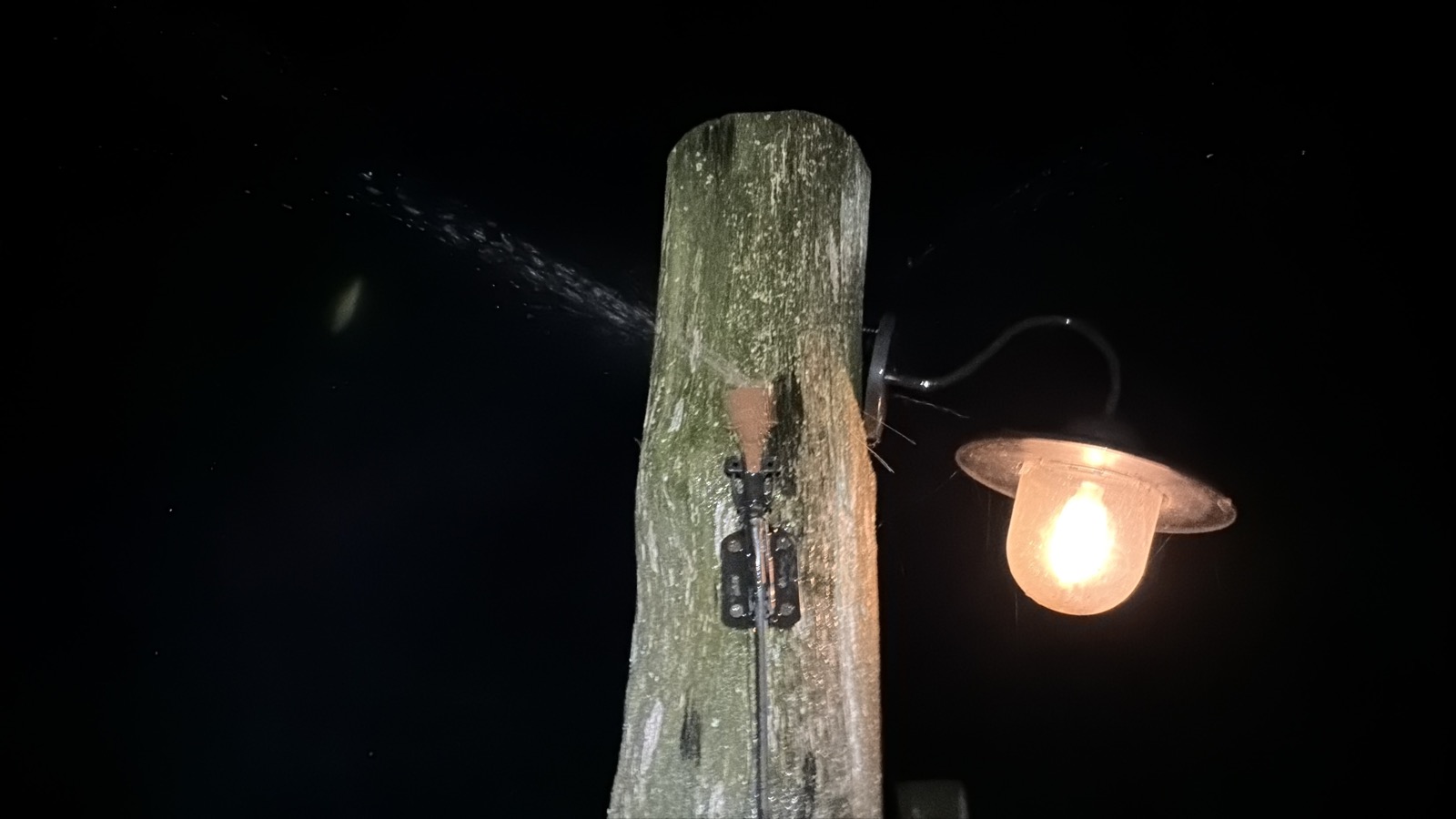
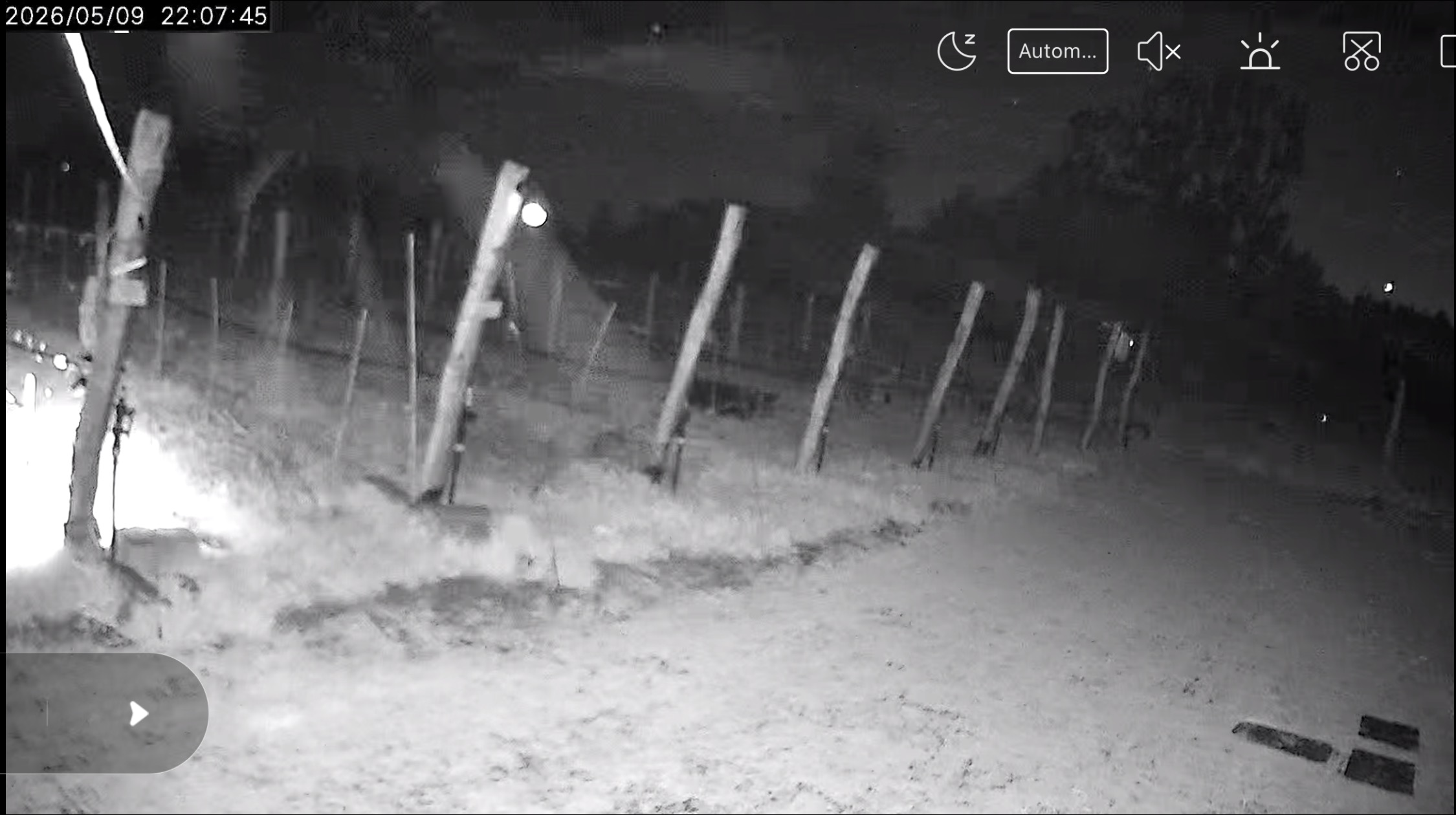
SMS, not push. At 2 am a push notification is silence. An SMS wakes you. The alert chain is: forecast from Open-Meteo says a frost is possible, station confirms a falling trend at ground level, SMS goes out, system starts the sprinklers, second SMS confirms. A human can override within minutes. On 8/9 May 2025 the first SMS came at 22:00, the cycle started remotely at 23:30, air dropped to minus 1.7, the ground sensor never went below plus 0.6, and every bud survived. Another time the controller went offline on a Friday afternoon, so the network had to be reset on site, followed by a minus 4.1 night watching four sensors. Automation does not remove the human. It moves the human to the right moments.
Cameras. One on the rows, one on a kestrel nesting box we put up for rodent control. Both useful, one of them mostly for morale.
A robotic mower. A Mammotion unit for the interrows. It has quirks, but it took roughly a third of the physical trips off the calendar, and mowing was the single most frequent reason to drive out.
A journal. Every spray, every kilo, every litre in every tank, first in a spreadsheet, now in the software we ended up building. When the excise office or the vineyard register asks a question, the answer is a lookup.
Order matters. If you do one thing, do the station and the SMS. If you do two, add the frost protection. Everything after that is comfort.
How other people do it
We are not the only ones commuting to vines, and the models differ a lot by country.
England: the commuter and the neighbour. Timothy Sarson runs Little Bursted, a small vineyard he reaches from South East London around work and childcare. His account of leaving the place for a fortnight in June and returning to hip-high grass, weeds shorting the electric fence, and a contractor bending half the vine stakes with an under-vine mower is worth reading in full (littlebursted.com, "Absenteeism on the Vineyard"). When he broke four ribs in peak season, the vineyard survived on a local farmer sending photos, friends strimming, and contractors spraying. His conclusion: that works for a month, not as a long term model. He also points out that English viticulture is largely a retirees' game, which is one answer to the remoteness problem: retire onto the land. We did not want to wait that long.
Australia: pay a professional. Contract vineyard management is a mature industry there. Companies in McLaren Vale, the Adelaide Hills and Victoria offer everything from "we do the bare minimum and you call the shots" to full management where the owner never touches a vine. Real estate listings for winery properties routinely mention that living off-site is manageable because a management team is in place. It is the cleanest solution and it costs accordingly.
USA: skip the vineyard. A large share of small, interesting Californian producers own no vines at all. They buy fruit and rent cellar space. One of them is literally named Absentee Winery. If the winemaking is what you care about and the land is not already yours, this is the model that removes the remoteness problem entirely.
Central Europe: the hybrid. Most small Polish, Czech and German vineyards we know that are run from a city do some mix of the above: a relative or neighbour who keeps an eye on things, a contractor for spraying, and the owners driving out for pruning and harvest. Almost none of them have automation. That is changing, slowly, and it is why we started building tools.
The common thread: nobody runs a vineyard remotely without either a person on the ground, a system on the ground, or both. Pick which one you are paying for.
The decisions that lock you in
Three choices are much harder to undo than the rest, and remoteness changes how you should make them.
Varieties and rootstock. If you cannot be there mid-week, disease resistance is not a nice-to-have. We would plant PIWI again without hesitation. We would also graft from day one; our own-rooted 2021 rows and grafted 2025 rows differ in vigour visibly from the road. And we would resist planting a variety because we like drinking it. One of ours is on its last trial season for exactly that reason.
Scale. A remote vineyard has a ceiling. Somewhere around one hectare the trips stop fitting into weekends and you need either automation on everything or a person. We are planning an expansion to roughly 0.8 hectares total, about 2,250 more vines, and the honest reason we can consider it is that the frost system and mower already exist. Without them it would be irresponsible.
Legal structure. Register early, before the volume exists. In Poland the small producer path (under 1,000 hl, reduced excise) let us do the paperwork while the vines were still young. Whatever your country's equivalent, it takes months and shapes what you can do later.
Is it a business?
Not yet. At 0.22 hectares, wine sales cover consumables and the occasional pump. They do not cover the sprinklers, the station, or anyone's time. At this scale they cannot, and we knew that before we planted.
What it is: a place the family actually uses, a working test site for the expansion, and the reason we started building vineyard software in the first place. If the expansion to 0.8 ha goes ahead and the sparkling wines land the way the site's acidity suggests they should, the numbers change. If not, we have an expensive hobby with very good records and a frost system that has saved two vintages.
Decide which of those outcomes you can live with before you plant. It is the only part of this you get to decide without the weather's input.
If you are about to do the same thing
- Be honest about which model you are in: commuter with a neighbour, owner with a contractor, buyer of fruit, or commuter with automation. Each is fine. Pretending to be one while budgeting for another is not.
- Put a weather station in the rows before you put a tank in the cellar.
- Plant for the climate and your absence, not for your palate.
- Set up SMS alerts for frost and leaf wetness in year one, even with no crop, so the system is proven before it matters.
- Keep records from the first spray. Reconstructing them later is where sleep goes to die.
- Expect to lose something to the distance anyway. The goal is to lose grass, not vintages.
Frequently asked questions
Do you need to live on your vineyard to run it?
No. You can run a vineyard remotely if you sort tasks by urgency: frost protection must happen at a specific hour, so you automate it; spray timing and mowing fall within a few-day window, so you use sensors and alerts; and pruning, harvest and bottling are batched into trips.
How much does it cost to start a small vineyard?
It varies hugely with land and equipment. On our 0.22 ha we spent about 6,800 PLN on frost sprinklers, around 600 PLN on an OpenSprinkler controller and roughly 300 EUR on a weather station. The land was family-owned, which changes the maths completely.
What is the cheapest way to start making wine?
Buy fruit and rent cellar space instead of planting. Many small producers own no vines at all. It removes the land cost, the frost risk and the remoteness problem in one move.
Which grape varieties are best for a low-maintenance vineyard?
Fungus-resistant PIWI hybrids such as Solaris, Seyval Blanc or Bianca need a fraction of the spray passes that vinifera needs in a wet climate, which matters most if you cannot be there mid-week.
How do you protect a vineyard from frost when you are not there?
Overhead sprinklers on a controller with a local API, triggered by a weather station in the rows and an SMS alert chain. Water releases heat as it freezes, keeping the buds near zero while the air drops below minus four.
Can a small vineyard be profitable?
At a fraction of a hectare, usually not. Wine sales at this scale cover consumables but not the equipment or anyone's time. Profit needs scale, a direct-to-consumer channel or a higher-value product such as sparkling wine.
We run VineyardElf on Winnica Pustkowie first: the frost logic, the alerts, the spray records and the vessel tracking described above are the same ones we offer to other growers. If something is annoying, we usually find out before you do.