The EU wine e-label obligation, and why it reaches Australian producers
Since December 2023 every wine sold in the EU must carry an ingredient list and nutrition information. Most of it can live behind a QR code, but the rules on what goes on the glass and what the linked page may contain are strict. If you export from Australia to Europe, this obligation follows the bottle across the border regardless of what FSANZ asks of you at home.
What EU law now requires, and from when
The trigger is Regulation (EU) 2021/2117, which amended the single market regulation 1308/2013. It made two things mandatory for wine: a full list of ingredients and a nutrition declaration. The obligation applies to wine produced from 8 December 2023 onwards. Wine made before that date can continue to circulate under the old rules until stocks run out, but anything vinified after the cut-off has to comply.
Crucially, the law lets you split this information between the physical label and a digital page reached by scanning a code. That is where the QR e-label comes in, and where most of the practical questions start.
On the glass versus behind the QR
Two pieces of information must be printed physically on the label and cannot be moved off it:
- the energy value, expressed in both kilojoules and kilocalories per 100 ml;
- the allergens, in practice sulphites, shown in the ingredient reference with sulphites emphasised typographically (for wine that is almost always relevant, since nearly every wine exceeds 10 mg/l).
Everything else, the complete ingredient list and the full nutrition table with fat, saturates, carbohydrate, sugars, protein and salt, may be provided electronically through the QR code. You do not have to crowd the back label with all of it.
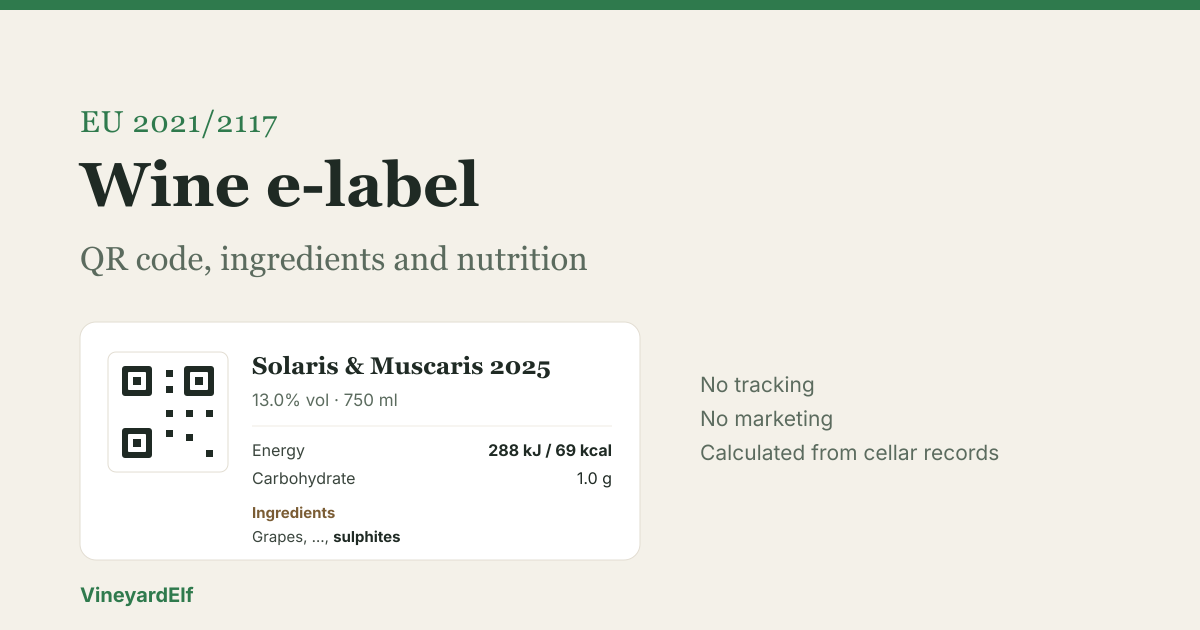
- Energy value: 288 kJ / 69 kcal per 100 ml
- Allergens: contains sulphites
- QR code labelled Ingredients
- Full ingredient list with allergens highlighted
- Full nutrition table in the standard 1169/2011 order
- Producer name and address, lot number, version
| Energy | 288 kJ / 69 kcal |
| Fat | 0 g |
| of which saturates | 0 g |
| Carbohydrate | 1.0 g |
| of which sugars | 1.0 g |
| Protein | <0.5 g |
| Salt | 0 g |
Grapes, acidity regulator: tartaric acid, preservatives and antioxidants: sulphites.
The word "Ingredients" has to sit next to the code
This is the detail people miss. Under the Commission's guidance (Notice C/2023/1190, point 38), a bare QR code or a generic "i" icon is not enough. The code has to be introduced by a heading that contains the word "Ingredients", exactly as a printed ingredient list would be. So next to the code you print the word, and only then does the digital list satisfy the legal heading requirement. For a wine sold in a given market that word appears in the required official language; for export you can add "Ingredients" in English alongside it.
The linked page must be dry and information-only
The e-label page is not a marketing surface, and the Commission is explicit about it. Points 30 and 34 to 37 of C/2023/1190 rule out anything that turns the page into a sales or tracking channel:
- no cookies, no analytics, no user tracking or data collection;
- no marketing content, no commercial language, no visual styling meant to add "attractiveness";
- no external links, including to your own shop, tasting notes or story;
- the scan must lead directly to the information for that one wine, with no intermediate pages or consent screens.
The page should be deliberately plain: producer name and address, wine name, vintage, category, volume and alcohol, the nutrition table in the standard order, and the ingredient list with allergens in bold. That is the whole point of it.
You can calculate the values, no lab required
A common worry is that nutrition figures demand laboratory analysis. They do not. The rules (and point 22 of the Commission guidance) allow the declared values to be calculated from average data: the producer's own known figures, generally established averages for the ingredients used. Energy is worked out from alcohol, sugars and organic acids using the standard coefficients, with kilojoules and kilocalories each derived from their own factors. For a small winery this is the difference between a form you can fill in and an expense you cannot justify.
The Australian angle: export is the trigger, not local law
If you make wine in Australia, nothing in domestic food law pushes you here. FSANZ does not require a nutrition panel or an ingredient list for wine sold on the Australian market. Left to the local rulebook, none of the above would apply to you.
The obligation attaches to the destination, not the origin. Any wine placed on the EU market after the cut-off has to comply, no matter where it was produced. For an Australian producer the trigger is simply exporting to the EU. The same logic applies to every third country: a bottle crossing into Europe carries the EU rules with it.
Australia is heading a different way at home. From 13 August 2028, wine sold on the Australian market must carry a physical energy statement, kilojoules per 100 ml and per serve, servings per pack and standard drinks, and a pregnancy warning has been mandatory since 2023. Neither is delivered through a QR code, and neither includes an ingredient list. So the EU duty to list ingredients and declare nutrition stays specific to selling into Europe, and it is the export itself, not Australian law, that brings it into play.
So if your export plan includes the EU, you need the energy value and allergens on the printed label, the word "Ingredients" beside a QR code, and a compliant, tracking-free page behind it, exactly as an Italian or Spanish producer would. Australia's own energy statement, by contrast, is a block of text on the physical label with no QR at all, so the two markets need two different outputs from the same underlying data.
How to get it done
The mechanics are straightforward once the data exists. The hard part is knowing what actually went into the bottle, and that is where a cellar record earns its keep. If your must preparations, additions and measurements are already logged, the ingredient list and the calculated nutrition values can be derived from that record rather than typed in from memory. Most e-label tools on the market ask you to key everything in by hand; building the label out of what you already recorded turns compliance from a chore into a by-product of good bookkeeping. Whether you sell in Warsaw, Berlin or export from the Barossa to Rotterdam, the requirement is the same, and the work is smallest when the data was captured as you made the wine.
How to prepare a wine e-label, step by step
- Collect the batch data. Alcohol level, residual sugar, acidity, additions and clarifying agents, ideally straight from your cellar records.
- Compute the nutrition and ingredients. Energy, carbohydrate and sugars are calculated from average data, with no lab analysis. The ingredient list comes from the batch history.
- Create the e-label and QR code. This produces a public per-batch page and a QR code that points to it. The page is plain, with no marketing or tracking.
- Complete the physical label. On the bottle, print the energy value (kJ and kcal), the allergens and the QR code labelled Ingredients.
- Print and test-scan. Export the QR at 12 to 20 mm (SVG, PNG 300 dpi or PDF) and scan the print to confirm it opens the right page.