
Ask ten small Australian producers what the Label Integrity Program requires and you will hear the same two numbers: keep everything for seven years, write it down within three days. Both are roughly right. Neither is what the Act actually says, and the gap between the shorthand and the text is where audits get uncomfortable.
We went to the source: Wine Australia Act 2013, compilation 42, in force since 21 February 2025, plus the Wine Australia Regulations 2018. Part VIA of the Act is the whole of LIP. It is shorter than its reputation suggests, and more specific. Here is what it asks of a producer who does not have a compliance department.
It applies to more people than you think
Section 39C does not limit LIP to wineries. It catches anyone who grows grapes that are wine goods, manufactures wine goods, or supplies or receives them, and that last category explicitly includes wholesale, retail and export. It also catches agents who take possession on someone else's behalf. The one boundary is origin: Part VIA applies only to the extent that the goods originate in Australia.
So the grower selling three tonnes to a neighbour is in scope. So is the neighbour. So is the contract packer who never owns the wine.
What the record has to contain
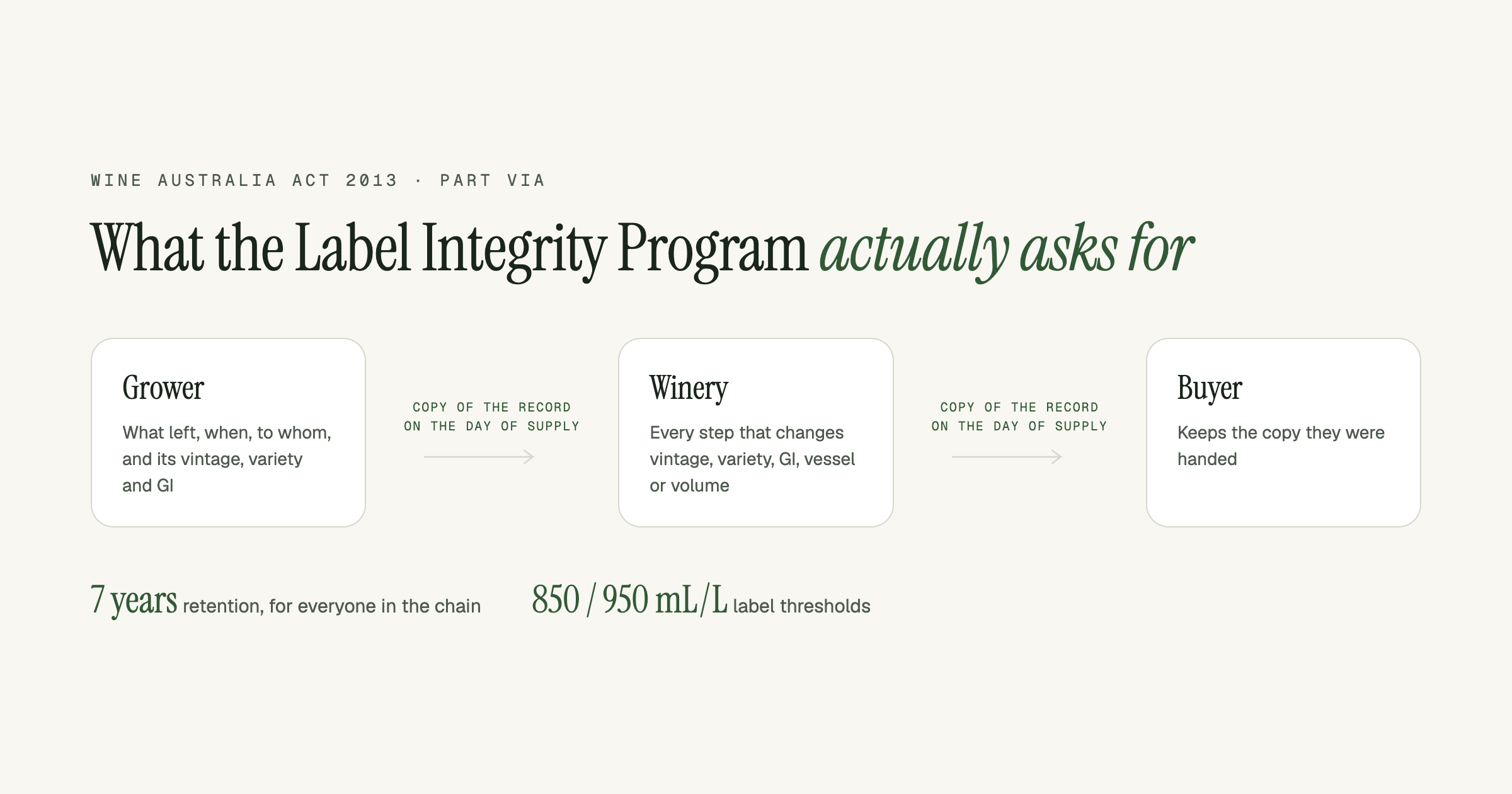
Section 39F(1) lists it plainly. Your identity. The kind of wine goods. The date you received them, from whom, how much, and their vintage, variety and registered geographical indication. Then the steps you took that changed any of the following: the vintage, variety or GI of the goods, the vessel they sat in, or the volume in that vessel. Then the mirror image on the way out: date supplied, to whom, how much, and the vintage, variety and GI of what left.
Read that middle clause again, because it is the one that catches people. A rack from one tank to another changes the vessel, so it is a recordable step even though nothing was added and nothing left the winery.
The seven years, and the three days
Section 39F(2) is precise in a way the shorthand is not. The retention period begins when the event occurs, or, if a record has to be made before it can be kept, at the end of three days after the day the event happened. It ends seven years after that time.
So the three days are not a grace period for remembering. They are the point from which the clock starts if the entry was not made on the spot. The practical effect is the same as the shorthand, which is why the shorthand survives. The difference shows up when an inspector asks when a particular entry was created rather than what it says.
The document you are supposed to hand over
This is the part most often missed, and it is the part with its own offence attached.
Under 39F(3), on the day you supply wine goods, you must give the person receiving them a copy of your record of the date, the quantity, and the vintage, variety and GI. Not a week later, not with the invoice at month end. On the day. Under 39F(4) the receiver then keeps that copy for seven years of their own.
The industry calls this a supply statement. The Act never uses the phrase, which is worth knowing when you search the legislation and find nothing. What it does have is 39K, which makes failure to provide that copy, or failure to keep one you were given, an offence in its own right.
What you do not have to keep
Section 39G takes two burdens off. A grower does not have to keep the receipt side of the record for grapes they grew themselves, which makes sense, since there is nobody to have received them from. And anyone who only handles wine already packaged for the consumer, without touching any label claim, is excused from most of the list.
That second exemption is narrower than it sounds. Touch a label claim, and you are back in scope for the lot.
Blends: proportions, not just components
Section 39H(4) is the clause that separates a tidy cellar book from a compliant one. For a blend, the record must show what proportion of the blend each component represents, and the vintage, variety or GI of each component. A list of what went in is not enough. The arithmetic has to be there.
Alongside it, 39H(3) asks that your record of production steps allow an audit trail to be readily traced, and discrepancies to be readily checked by following the sequence of steps recorded. That word "readily" is doing real work. A shoebox of correct notes that takes two days to reconstruct is not an audit trail.
And 39H(2) defines identity as sufficient particulars of name and address to identify the person, plus the name and address of the winery where goods came from or went to one. A first name and a phone number will not do.
The label thresholds are in millilitres, not percentages
Everyone says 85 per cent. The Wine Australia Regulations 2018 say 850 mL/L, and the distinction matters because the same regulations contain a second threshold that the 85 per cent shorthand hides completely.
- Variety (section 25): a single named variety needs at least 850 mL/L from that variety. Name several, and they must total 850 mL/L, appear in descending order of proportion, and each named variety must exceed any unnamed one.
- Geographical indication (section 26): one Australian GI needs 850 mL/L from that region. Two or three GIs need 950 mL/L in total, with at least 50 mL/L from each, listed in descending order.
- Vintage (section 27): a single vintage on the label needs 850 mL/L from that harvest. Otherwise every vintage has to be listed, descending.
- Country (section 24): wine from grapes grown in more than one country must state the proportion from each.
If you buy fruit from several regions, the 950 and the 50 are the numbers to write on the wall. They are also the reason the blend proportions in 39H(4) are not busywork: the label claim is only as defensible as the arithmetic behind it.
One more definition worth knowing. Section 5D of the Act ties origin to where the grapes were grown, not where the wine was made. Trucking fruit across a GI boundary does not move its origin, in either direction.
What happens if the records are not there
LIP is enforced criminally, not administratively. Section 39J makes it an offence to fail to keep a record, to make a label claim that your records contradict or cannot support, or to knowingly keep a false or misleading record. Section 39K covers the supply copy. Each carries a penalty of two years imprisonment.
Prosecutions can be brought within seven years of the requirement arising (39L), which lines up neatly with the retention period. Wine Australia can demand records in writing under 39ZAA, and the notice must allow you at least 14 days. Refusing is another two-year offence under 39ZAB. If records are produced, the Authority may hold them for 60 days under 39ZAC, longer if a prosecution starts.
Nobody expects a small producer to be marched off over a missing tank transfer. The point of the criminal framing is that LIP exists to protect the credibility of Australian wine as an export category, and the enforcement tools are sized for that job rather than for yours.
How to check any of this yourself
The Federal Register of Legislation has an open API, no key and no registration. The Act is C2004A02362 and the Regulations are F2018L00286.
One warning, because it cost us an afternoon. The obvious URL, legislation.gov.au/<ID>/latest/text, returns a table of contents rather than the text of the sections. For the Act that is around 61,000 characters in which the word "years" never appears once, which is a very convincing way to conclude that a rule does not exist. The full wording lives in the document files, reachable through the API's documents endpoint.
Always check isInForce and the version date before quoting anything. The compilation we read here started on 21 February 2025.
What this looks like in daily work
Strip out the section numbers and LIP asks for four habits. Record what came in and where it came from, with its vintage, variety and region. Record every step that changes a batch, its vessel or its volume, including the ones that feel like nothing happened. Keep the proportions when you blend, not just the ingredients. And hand the buyer their copy on the day the wine leaves.
That is a bookkeeping problem before it is a compliance problem, which is the good news: it is the kind of thing software should be doing in the background while you work the cellar. It is why our batch cards now carry the supplier, variety, vintage and region of every component, and why the blend card works out each component's share by itself rather than waiting for someone to do it on paper before an audit.
If you are coming at this from the European side, the shape of the stack is different from what you know. We compared the two in vineyard paperwork, EU versus Australia, and the short version is that Australia does not hand you fewer forms, only differently shaped ones.
This is not legal advice. Practice varies, your situation varies, and a rule read correctly can still be applied in a way you did not expect. Confirm anything that matters with Wine Australia or your own adviser before you act on it.